Across the fen

Across the fen
Showing posts with label Yacht. Show all posts

Wednesday, 8 July 2020

"Who pays the piper calls the tune"


The concept was very simple.

When the travelling musicians came to our village we could pay them,  or not.
If we paid them we could ask for a tune,  to which we might dance.   If others in the village wanted to listen and dance to the same tune we might let them,  or not;  it was our money.
Often we would put money into a small chest so that everyone paid the piper.
Before the author was born,  of course,  but he understands the concept:  he was once a Morrisman..

The concept was similar when the author was a young man.
If I put sixpence into the jukebox I could choose which record was played.   If you paid,  you chose.
Occasionally the local bully would intervene and,  using his superior strength and inferior sensitivity,  would wait until the sixpence was inserted and then press his predetermined button.
But we didn’t let that happen often;  if he was in the cafe we went elsewhere.   If he came in,  we went out.   The cafe proprietor (no fool!) quickly understood and banished the bully.   Henceforth,  “Who inserts the sixpence calls the tune”.

And then the author was no longer a young man.
He bought a boat.

Actually,  over the years he bought several boats;  sometimes more than one at a time.
He paid his money and bought the boat he wanted.   (or thought he wanted!)
Some were very small,  8 or 10 feet (say,  3 metres);  the biggest was 22 feet (7 metres).
He sailed on the Avon,  on the Severn Estuary,  on the Crouch and in the North Sea.   He was troubled by Authority once.   On the Avon he was asked for his river licence;  who knew?
It seemed fair.   The river needs maintenance and those who use it should pay.   The licence fee was a bit high,  he thought,  for a single use:  could he pay by the day or even by the hour?   Sadly no;  by the season.   So he didn’t go back.
No authority on the Severn,  the Crouch,  the Deben,  the Orwell or the Stour ever asked the author for a licence.   You don’t need one for the North Sea.   The author understood SOLAS,  the IRPCS and insurance (he’s taught navigation for some years).

A legacy (from M’s father) paid for a narrowboat.   A fairly cheap boat,  with ply inside rather than wood,  and with a BMC/Thorneycroft diesel under the cruising deck.   The Conservators of the River Cam demanded a licence fee which,  again,  seemed fair.   They pretended to maintain the river,  although in reality they focussed entirely on the rowers and especially on the needs of the Cambridge crews.
The concept of paying the piper and calling the tune was stretched a bit thin.   It seemed that the boatowners paid the piper to play the only tune he knew.
It rather reminded the author of the BBC.   In his youth and early middle age owning a wireless (radio),  and then a television meant that you must pay a licence fee.   This entitled you to listen to,  and watch,  the very few programmes (channels) which the BBC broadcast.   The radio listener paid the piper and listened to the only tune he played.
But the BBC licence-payer had some influence;  public opinion persuaded the BBC to broadcast the programmes which the public said it wanted.   Of course,  not all individuals of the ‘public’ agreed on what they wanted,  but the individuals had some choice,  and,  over time,  the choice broadened.

The author and M (and their sons) enjoyed the narrowboat for many years.
It was insured,  of course.
This is a scheme whereby the owner pays a company which promises to repay the cost of the boat if it’s lost,  damaged or stolen.
At least,  that’s broadly the idea.   Within certain limits the owner can pay for whatever insurance cover he thinks he needs.   The insurance company retaliates with ‘small print’:  a long list of things with which the owner must comply if he’s to get the money when the boat is lost,  damaged or stolen.   If the insurance company thinks you didn’t look after it properly,  you won’t get your money.
Imagine the piper coming to the village with a pre-prepared list of tunes.   You can pay for one,  or any;  but you must sit still and listen carefully.   If you cough,  or your stool squeaks,  you’ve broken the contract and you don’t get your tune.   Dancing is extra.   If you agreed to the contract,  that seems fair enough.

And then Authority decided that boaters were not safe.   (The people,  not the hats)
One or two boatowners had allowed gas to leak into their bilges and had blown themselves up when they lit the stove.
One or two had kept their engines running overnight,  for warmth, and had killed themselves with Carbon Monoxide.
If they don’t blow up,  or poison,  anyone else isn’t that their prerogative?

And so the Boat Safety Scheme was born.
You won’t get insurance or a river licence until your boat has passed the Boat Safety Scheme Inspection.
If you don’t get a river licence the Conservators of the River Cam will hound you for a few months and then impound your boat.

As the author types this the Boat Safety Scheme Inspector is inspecting the narrowboat.
He’s a remarkably pleasant,  affable young man *,  quite unlike the chap who came last time.

If he is the piper,  we have paid him,  whether the boat is deemed safe or not.
We have absolutely no say in the tune being played.

As an RYA instructor the author decided to use the narrowboat to teach Inland Waterways Helmsmanship.
The RYA licence fee (to be an instructor) is almost as much as the river licence (which is much more than it was because the boat is now a commercial vessel!).   This RYA licence allows the author to teach and to issue certificates.   It also covers the cost of an inspector to inspect the boat and the instructors.

We’ve seen this before,  with the BSS:  we pay the piper and the piper calls the tune.

*
He was pleasant and affable both before and after the boat passed its inspection!


Friday, 18 January 2019

Challenger

Gerry had arranged to take ten cadets aboard one of the TSYT Challengers for a week:  he needed another adult volunteer;  he preferred one with some sailing experience.
Guess who had sailed a Challenger some years ago!   And guess who agreed with alacrity!!

We met at 0830BST on Monday outside the school and assembled the luggage.   Some of the youngsters were travelling light:  a sleeping bag and a small holdall.   Others had brought everything they might (or might not) need for a month on a cruise liner.
They were all lads;  no lasses.   This was not sexist:   the layout of a Challenger is such that there must be an equal number of lads and lasses,  and not enough lasses elected to go.
Lads in a group tend to go feral quite quickly;  as we assembled at the bus it had already begun.
Gerry was more afraid of a 'starburst' and that he might lose cadets to all points of the compass;  that, too,  had already begun!

The drive to Portsmouth (ably executed by Brian) was boring.   The halfway stop at a service station on the A3 was nothing special (apart from the mini-starburst!).   The arrival at Gunwharf Quays was unremarkable.   Chas,  as ever,  was cheerful and smiling when he met us,  but the lads were horrified at the prospect of carrying their own kit half a mile to the boat.

But the sight of the boat was electrifying.   It brought back exciting,  long-forgotten memories to those of us (me!) who had sailed her before.   The long,  clean hull.   The tall mast.   The snake-pit of lines,  ha'lyards,  sheets and winches.   The stowing of kit and allocation of bunks.   The explanation of the heads.  The skipper's briefing.   The galley and the saloon.

We moved out of the marina about mid-afternoon and headed South down the channel.   At 5q-Outer Spit South Cardinal we turned West along the Solent.
It was a lovely afternoon,  calm water,  little wind and a sinking sun ahead.
There were no marina spaces at Cowes and we found ourselves alongside the breakwater in the North Basin.   With the tide falling the ladder became longer and longer:  the cadets had hoped to run ashore,  but the skipper thought the ladder too dangerous.   As the Westerly breeze rose the boat was pushed away up to 2 metres from the wall,  and reaching the ladder became almost impossible.   The lads were not pleased.   One or two had already decided that they wanted to be anywhere except on a boat.

High water on Tuesday morning made the ladder shorter,  so they used the marina showers and heads and felt a little better.

The weather had deteriorated and the wind had risen,  but the waves in the Solent had not yet built.
The lads were taught how to set the yankee and the staysail and we sailed Westward into the teeth of the rising gale.   Half a dozen tacks later we reached Yarmouth to discover that the skipper had recorded Force 8,  gusting 9,  during the afternoon.
Once again we moored on the breakwater,  this time within a few metres of the Ferry terminal.   but this time the wind pressed the boat against the ladder and running ashore became straightforward.

Wednesday was race day.   Three closely matched Challengers around a standard triangular course.
Your author hates racing.   It pushes people and machines to their limit;  sometimes beyond their limits.   With luck the machine breaks before the people break,  but the people always become aggressive.  Or perhaps those who race do so because they are already,  by nature,  aggressive.
Your author allows that the drive to win fosters improvements in the design and construction of the machine and,  possibly,  in the skills,  strength and fitness of the people.
The lads were bored.   When racing a big yacht the skipper and mate are intense and focussed;  the helmsman (in this case,  your author) did his best.   For the crew (the lads) it was hours of waiting punctuated by minutes of frantic hard work.
We came second.
That evening,  back in Cowes,  they desperately wanted to run ashore.

Thursday was a gentle day.
The afternoon and evening were devoted to the classroom.   The navigator showed them around a chart of the Solent and helped them with a night pilotage plan.   For the first time they were enthusiastic and excited.
The night exercise went well and the boat was sailed safely into Gunwharfs Quay.

Did the lads enjoy the trip?   It was hard to tell.   On the long journey home some slept and some used their smartphones.
Landlocked Sea Cadets!   It makes one wonder.

Wednesday, 11 February 2015

Out of Brancaster

Brancaster is a little village on the North Norfolk coast. The staithe is a gravel track and beach onto a tidal channel which, at low water, dwindles to a muddy creek winding through the salt marshes.
Sailing is alive and well. The higher parts of the bank, not quite reached by the Spring tides, has rows of sailing and rowing dinghies. There is a yacht club, and the yachts are moored in the creek. Across the road is a well-advertised RYA training centre.

The Harbour Master is a laconic, friendly man who clearly knows the creeks and marshes well. He once knew, and sailed with, Frank Dye: that is testimonial enough for any sailing man. He gave the impression of ruling his littoral empire with a firm hand: he wasn't going to let Opal into his water until he was sure her skipper knew what he was doing.
She arrived fairly early, to a deserted staithe. As she was eased onto her trolley, her gear loaded and her mast stepped, sailors stopped to admire, to comment and to ask. The process of rigging takes twice as long at the water's edge as it does in her home driveway. Everyone takes an interest.

Eventually, with the car parked and the trailer padlocked, Opal slipped into the water. Her wheels were moved from under her keel and stowed above the stern locker. Her skipper made himself comfortable in the after seat, and she floated out into the moorings.

The Mirage drive is very deceptive. In calm water like this Opal glides along remarkably quickly. The muscular effort is far less than paddling a canoe or kayak.

East of the moorings, her sail was unfurled. Despite the absence of a boom Opal sails fairly close to the wind. Not as close, obviously, as a Bermudan rigged dinghy, but what she lacks in windward ability she gains in speed. Only in light winds need the sail be fully unfurled.

The channel at Brancaster curves in a long bend Eastward through Northward and then Westward, widening as it does so. North of the creek which runs East to Overy, the channel is exposed to the North Sea. At this state of the tide, about two hours before high water, the outer banks were covered; the wind turbines turned slowly in the haze.

A twenty-two foot Jaguar, under engine, turned abaft Opal's stern as she tacked to the North-West, the two crew calling a cheerful greeting.

A little gaff cutter with tan sails (perhaps a Cornish Shrimper?) followed Opal tack for tack, but falling behind. As Opal turned toward the West and over the bar, now safely under several metres of tide, the little cutter sailed N'East to play and tack under the lee of the banks.

Now clear to the North of the bar and the banks Opal began to feel the short swell of the shallow North Sea. She has a way of rising to the coming wave, climbing the face, cresting the ridge and then smacking half of her eighteen feet down into the following trough.

Roughly in the spot where the fairway buoy used to be, Opal's skipper noted the bearing to the Golf Club and its lighthouse, the angle of the approach channel and the breakers over the banks to the East. He furled the sail, broached the coffee flask and opened his packed lunch.

The early Autumn sun was warm, the breeze gentle from the N'East. The padded seat was comfortable, the motion soothing.

At the top of the tide a couple of yachts sailed in from the North and across the bar into the channel. Away to the S'East the tan sails tacked across the flat water in the lee of the banks. The wind turbines continued to turn lazily in the haze.

Smoked salmon and pastrami, with grapes. Black coffee. Cold, clean water. A chocolate biscuit. The sea curiously warm. The swell rising and falling like the heaving chest of a sleeping monster.

Lunch over, Opal turned South and East, bouncing over the short swell and then, in flat water, planing along, windward ama in the air, the hull and l'ward ama fast-skipping across the ripples. A crossing tack with the little cutter, Opal passed well ahead and hurtled onward. As the channel curved she bore away further under the N'Easterly breeze until she was running downwind toward the moorings. Reefing half the sail did nothing to slow her progress. Finally, down to a scrap of triangle, she cruised into her landfall.

Sail furled, Mirage drive out, centreboard and rudder up, and Opal scraped her bows onto the shingle. Her skipper stepped out into inches of water, hauled her dry and unstepped her mast.
Brancaster is a place to visit for a day on the water. Opal is easy to launch and recover, the staithe is quiet and friendly and the water is a calm expanse or the open sea. A perfect day out.


2 October 2015

In the August 2015 edition of Practical Boat Owner Andrew Simpson suggested using the Navionics WebApp for harbour planning.   It can’t,  he suggested,  be used for passage planning because it has no lines of latitude or longitude and none of the functionality of the full application.
It does,  however,  have a scale cursor which can be orientated North-South,  or East-West (or indeed any other direction).   Perversely,  it calls this orientation “Heading”, which it most certainly is not.
The bearing from Brancaster to Skegness is 311°T,  a little over 15 miles.   There and back might be a decent one-day cruise.
‘Woolpack’ PHM is part way along the bearing line,   6 miles from Brancaster and about 10 from Skegness:  well situated at the centre of a GPS web for the little hand-held Garmin GPS.

Opal arrived Brancaster 0900 and was rigged and afloat by 0945.   Half a mile down the channel,  the skipper realised that the bungs were not tight and that the hull was taking on water.   He put ashore to drain the water and tighten the bungs.   Was this an omen?   A superstitious sailor might have had second thoughts.

Leaving Brancaster was easy:  East down the channel through the moorings,  North to the channel markers,   West to the golf club and then onto a heading of 315°T toward Skegness.
The presence of the wind farm made bearings and headings almost redundant. It was huge,  and it's presence dominated the Northern skyline.

The morning shone and the sea sparkled.   The slight state of the sea provided a popple which made Opal lively,  and the gentle Easterly breeze kept her moving at 4 to 5 knots over the ground.

A white patch on the horizon might have been buildings on the Skegness coast,  so was kept on a constant bearing.   It turned into a ship,  which was not moving,  but needed to be avoided.   In any case,  the SE corner of the windfarm was kept fine on the starboard bow.
The ship became Stril Explorer flying "restricted in ability to maneouvre" above and abaft the helicopter landing platform.   Either the tide was pushing hard to the North (bearings on a couple of buoys made this seem unlikely) or she was moving sideways to the South?
A crane on her port side was deploying something that might have been an ROV.
Opal passed her to the South,  having found 'Woolpack' PHM exactly where it should have been.
Then a heading of 315°M picked up the Special marker on the SW corner of the wind farm.

Calculation of the tides suggested that Opal should turn for Brancaster at about 1330.   In the event (perhaps a mistake) she  pushed on until 1400,  about a mile and a half from Skegness beach,  before turning SE close hauled.
Was this success or failure?   The objective had been to reach Skegness:  did that mean landing on the beach,  or was a mile away good enough?
The skipper didn't really care:  it was a wonderful day,  he was warm and the boat was behaving beautifully.

On the way back he kept the little boat close hauled,  steering between 120° and 150°M:  this kept Brancaster on a constant bearing of 140°T.   But then the skipper needed to pass water (again!).   This meant furling the sail and the complicated ritual with the dry-suit.   They drifted downwind,   West and a little South,  until,  when the sail was set again,  Brancaster had come to 120°T.   Close-hauled and with significant leeway Opal could not now make the harbour on this tack.

The North Norfolk coast is fairly featureless,  especially in the gloaming,  but a building on the shore looked very like the golf club.   The chart suggested it had a lighthouse?   At what time would the light be lit?   How far East should Opal go before looking for the channel?   Which would come first;  darkness,  the channel or the lighthouse?

As the golf club came abeam darkness fell like a slowly lowered blind.   Random red or green lights,  sometimes long,  sometimes short,  often absent,  hinted at the channel.   Opal crept forward,  against the faint breeze,  with the tide and controlled by her pedals and rudder.   The surf crashed somewhere to starboard (perhaps the shoreline),  and a long way to port (perhaps Scolt Head?).   Now the channel markers became more consistent.   Heading East gradually became heading South and then West.   The Staithe ran South from the East-West arm of the channel,  but the blind of darkness concealed everything.   A yacht,  moored in the channel,  wisely showed an anchor light at the top of the mast.   But it dazzled Opal's skipper and ruined his night vision:   the darkness was deeper than it need have been.
The Staithe could not be found and now Opal was too far West and the flood was running fast.    Turning East,  the Mirage drive made desperately slow progress,  and Opal turned into a pool amongst the marsh grass for a pause,  a rest and a meal:  time to think.   And to wait for the moon.   She would reveal everything.

As the last quarter rose from the Eastern horizon so did the clouds.   Nothing was revealed.

As the tidal stream lessened toward high water Opal again moved East,  searching for the elusive Staithe.   Five times she ran aground on the marsh grass exposed by the falling Spring tide,  and five times the skipper dragged her off into deeper water.   He was exhausted.   It was 1115,  and he had been awake and navigating,  by road and by sea,  for over eleven hours.
A mooring buoy appeared between the hull and the port ama:  he grabbed it,  and made fast the painter.   Time to rest.

The tiny cockpit of a Tandem Island is perfectly shaped for sitting.  The seat can be adjusted to sit upright or to recline.   From it the boat can be sailed,  paddled or pedalled in complete comfort.
It is the worst place in the world in which to sleep.

Shivering is good;  it keeps your muscles working and your body warm.   The time to worry is when the shivering stops.  They kept shining that light,  faint but soul-searching,  across his face.   Was this some kind of cruel joke to keep him awake as he tried to sleep . . . . ?   And that hideous screeching racket,  like seabirds fighting over scraps of fish and chips?  And the smell of stinking East Coast mud.

Two o'clock in the morning.   The seabirds were fighting over worms and shelled things in the mud.   The last quarter was shining through the thinning cloud.
With the tide ebbing,  and the banks exposed,  the Staithe might now be easy to find.
Sitting up and persuading cold,  cramped limbs to work was hard,  but ultimately successful.   Released from her buoy Opal responded to the fierce ebb,  being swept along with no chance of entering the Staithe,  even if it could be seen.   Which it couldn't.   Eventually she came to rest on a sandbank,  and the water became little chuckling channels which dwindled and dried. 
Back to the curled,  cramped,  confined cockpit.

That light is too bright,  but the air smells fresh and clean and the screeching has turned into vigorous honking.

Five o'clock.   The Eastern sky began to glow rosy pink and gold.   The sand was firm (in places).   A fisherman trudged across the estuary,  waded through the river and crossed the marsh on his way to his boat.   The tide probably turned at five and might lift the boat at seven-ish.
He dragged the Hobie into the river and began to haul it upstream.   Every hundred metres or so it had to be pulled across sandy shallows bedded with soft silt (quicksand?).
And finally dawn.   And then the Staithe,  clear and obvious with all the familiar land- and sea-marks to guide him in.

He pulled the boat up onto the shingle,  unstepped the mast,  collected the bag of instruments and guided his groaning legs to the car.   Removing the dry-suit (he'd worn it for nearly 23 hours) was a profound relief.   Comfortable shoes,  and then back to the boat.   Day sailors were preparing their dinghies and outboards.   A small group was helping a newcomer rig his Wayfarer,  and park his road trailer.   An efficient-looking sailor carried a bundle of boat cover from his dinghy to the clubhouse.   The Staithe was waking up to weekend watersport.

At the shingle he watched in disbelieving horror as the Hobie drifted up-channel on the tide.

A group around a Wayfarer confirmed that they had no safety boat to help and would not themselves be on the water for another hour.   Two men with an outboard dinghy pondered on where a drifting boat might end up,  and whether it would be accessible,  and that the channel upstream would be too shallow,  and that it might end up neaped on the marsh.   Perhaps it would float back on the ebb?
The efficient-looking sailor was just that.   He and the Hobie skipper embarked in the tiny dinghy and set off after the errant trimaran.   Twice they ran out of water,  and had to look for another way.   Eventually,  with the Hobie entangled in a mooring line just twenty metres away,  they stuck fast on a bank.   The skipper stripped off his shoes and socks,  jumped in knee-deep and ran toward his boat.   He was barely 5 metres away when it untangled and drifted off again.   And now he was thigh deep in a rising tide. 
The efficient-looking sailor had shipped his oars,  found a deeper channel and caught the runaway!
As he brought it back the skipper was waist deep and preparing to climb onto a moored boat.  Instead he boarded his Hobie,  and steered it behind the tiny dinghy back to the Staithe.   The efficient-looking sailor  brushed away the profuse,  embarrassed,  inadequate thanks:  "You'd do the same for me;  I know you would.   Anyone who wouldn't isn't worth knowing."

This time he dragged the boat out of the water completely,  and up the bank.   He ran to the car,  hitched on the trailer and hurried back to the boat.   It's stern was already in the water!   As he loaded it onto the trailer the Wayfarer sailors launched around him,  oblivious to the ending of the dangerous drama.   The efficient-looking sailor had loaded his passengers into the dinghy and was taking them down-channel to the boat.   Saturday morning,  and life was perfectly normal.

Back in the car park,  he secured the boat,  the trailer and the car for the journey home.   He was aware that,  in his exhaustion,  he had made dubious,  dangerous decisions.   Now everything must be checked and double-checked.   Every part and component must be touched and confirmed.   Today the sea had teased and then forgiven;  the road would not be as friendly.
Even so,  he had to stop after half a mile to fasten his seat belt!
At the little cafe the coffee was hot and strong:  he drank three cupsful,  and then sat in the car to get warm and to let the caffeine do its work.

The road journey was totally uneventful.

A New Cruising 'chute

A cruising 'chute is not, despite its name, a parachute: the flow of air is completely different. Nor is it a spinnaker, although the airflow across both is the same; that is, from luff to leech.

It's more like a large, lightweight genoa, in that it has a luff, attached at the head to a ha'lyard and at the tack to the stemhead: it is triangular, with the foot and the leech meeting at the clew, where the sheets are attached. Both sheets pass forward of all stays and of the sail's own luff-rope, and pass, outside all, to blocks on the quarters, and thence to winches on the coamings.

It's not, usually, a staysail: it carries its own luff-rope from head to tack, and is set flying.

The tack is not changed as it is with a square-sail or a spinnaker. Changing the tack of a spinnaker is a cumbersome, skilled business of moving the spinnaker boom across the foot of the sail, so that the former tack becomes the clew, and the former clew becomes the tack. This is usually done with the wind astern of the boat. The tack is changed while wearing ship (in modern speak, gybing).

To take a cruising 'chute from one tack to the other, the clew is passed forward of the sail, and sheeted down the other side of the boat. This takes fewer people and less skill than changing the tack of a spinnaker. But it can't be done head to wind: only by wearing ship.


StJohn had suggested (in conversation, as you do) that sailing Saga downwind in light airs would be easier with a cruising 'chute than with her heavy genoa. He'd drawn from his father a horror of sailing downwind under a boomed mainsail, with its attendant preventer and collapsing genoa. Both had the skill to helm goosewinged, but found it concentrated and tedious work; one can never sail in a chosen direction. 
So Julian became the proud owner of a brand-new cruising 'chute.

A sunny, calm day in November was the perfect opportunity to try out the new sail, especially since he had found a sailing Buddy attributed with some knowledge of these things.
First try, of course, with the boat secured to the pontoon.
From its bag, the sail was enclosed in a long sock, or snuffer. One end (becoming the head of the sail) was snap-shackled to the spinnaker ha'lyard, and hoisted aloft. The other end (which became the tack) was attached to a long tack-line which passed through a block at the stem-head, and then aft to the cockpit.

Aft of the pulpit, or forward?

The instructions said forward, but it didn't look right. The tack-line fouled the top of the pulpit and slid side to side across it, threatening the safety of the lights. Saga's forestay, unlike many, is 12 or 14 inches abaft the stemhead; leading the tackline abaft the pulpit placed it well forward of the forestay. The wise old buddy and the enthusiastic new skipper argued happily for a long time, over coffee. Isn't this one of the joys of cruising under sail?
Attaching the sheets exposed several dilemmas. The sheets are modern and synthetic. They are slippery blighters, and will undo almost any knot as soon as your back is turned. And they did.
It became clear, too, that if either of the sheets was allowed to slacken it would fall into the water, pass under the forefoot and slide along the keel. On the way it would snag the log impeller, the propeller and the rudder.
The sail having been hoisted, but not set, the moorings were slipped and Saga moved gently out of the marina into the flooding Crouch.
The zephyr from the South West was perfect. The snuffer was lifted and the l'ard sheet hauled. The new sail blossomed in all its glory, like a blood-red, radial-cut rose. It gave 2.5 knots through the water which, against the tide, gave less than half a knot over the ground. A few degrees of helm to windward sent Saga ferrygliding toward the moorings and the Northern bank; a few degrees to l'w'rd and she crossed to the Southern bank. An hour and a half against the flood brought the Royal Corinthian's abeam; perhaps half a mile from the marina entrance! No other test of the efficiency of this lightweight sail could have been better.

So Saga turned upstream.
nn
The snuffer tamed the curved, turgid expanse of thin nylon in a moment. Two or three minutes later the ha'lyard was unhooked, the tack-line and the sheets coiled, and the whole thing was bundled below. The test results were improving!
By then the marina was abeam: 100 minutes against the flood and 8 with it!
By the time the main and genoa were set Saga was well into Cliff Reach: less than 1 knot through the water and 3 over the ground, with the Spring tide covering the saltings and making the channel, wide as it is, difficult to see. Bridgemarsh Island had disappeared.

Opposite Bridgemarsh marina, in Raypits Reach, Julian again brought out the 'chute while his Buddy held station in mid-stream. The ha'lyard worked perfectly but, by the time he'd reeved the tack-line the ha'lyard was three times 'round the forestay. As he attached the sheets they wriggled themselves into every possible wrong arrangement.
It's surprisingly difficult. whilst standing on a squirelly foredeck, surrounded by a network of lines, sheets and tacks, even to see where they are, let alone see where to reeve them.
And then the whole assembly tucked itself neatly around the wrong side of the forestay, and the boat had to be gybed twice to coax it back.

But finally it was done. The genoa was rolled away, and the 'chute liberated from its snuffer. Blanketed by the main, it sagged into the water.
Then, main handed and zipped away, the cruising 'chute showed its real value. A broad reach along Easter Reach and a fine (too fine!) reach along Cliff Reach brought the marina abeam once more.
The engine started at the first touch of the button, the snuffer doused the 'chute without a hitch and Julian slid Saga into her berth with millimetric precision.

Monday, 4 August 2014

Boat Buddy

A boat buddy is a wonderful thing.   In some ways.

You've bought a boat;  your pride and joy.   You've sailed a little and you've passed your Day Skipper exams.   Now you want to go to sea.
Well;  down the estuary and back.   Or upriver and back.
Let's face it,  you're a little apprehensive.   What you need is a boat buddy.   Someone with experience,  to keep you out of trouble.   Someone with compassion,  to forgive or ignore your mistakes.   Someone with patience,  to overcome your ignorance.   Someone with fortitude,  to keep you going in the darkness of fear.

The Skipper's friend had recommended his own father as just such a paragon of sailing.   The candidate buddy had been to see the yacht,  ashore in the yard;  her bottom freshly antifouled,  her bilges cleaned,  one or two seacocks jammed,  her engine untried;  and had admired her (a wise and politic move from a buddy hoping to sail with a doting new skipper.   In this case,  the admiration was genuine;   this buddy has no concept of dissimulation or ingratiation;  friendly social discourse is a stranger to him.).

Friday, 23 May 2014

To Oban

16 August 2013
The road journey to Oban is becoming almost familiar.

The overnight stop this time was at the Loch Lomond Arms, a strong, one-time coaching inn not quite overlooking the loch. Naturally, Jane misbehaved; but, in fairness, it was mostly the fault of the fool who put the wrong address into her search chip.

Margaret loves boating, so a trip around the loch by steamer (sorry, by diesel launch) was compulsory: it was an excellent way to wind down after the road journey.
The delicious evening meal at the hotel made a perfect end for the day.
The second part of the journey was, of course, short. M was planning to stay at the Oyster Inn and arrived in time for a substantial lunch in the bar.

These sailing trips are largely about eating, aren’t they?

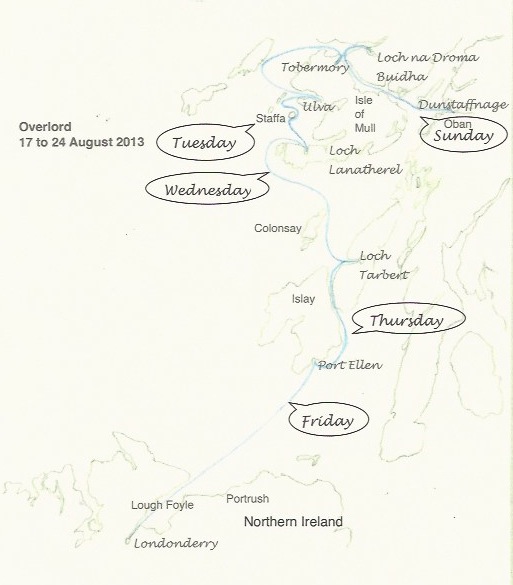
Oban was, as always, a little dismal; it always rains. It rained at Dunstaffnage, too, but then the anticipation and excitement of the coming voyage woke up the butterflies. The water in the anchorage was calm and grey; the boats bobbed gently at their moorings, as boats do. Overlord was at the end of a hammerhead, as far from the gates as could be, and the lady in charge wouldn’t allow entry without a substantial offering.
The chap in the Wide Mouthed Frog was a little friendlier: his coffee was good and not too expensive.

The skipper,  Tony,  and the rest of his crew (Frank,  JohnC,  JohnSc (Mate),  JohnSt,  Miggie,  Richard) arrived during the afternoon,  having met on the train from Glasgow.   The substantial offering was made,  the boat was opened up,  berths were allocated,   coffee was brewed,  menus were written,  anchorages were planned,  provisions were bought and a gourmet evening meal was cooked and eaten.

The voyage was to start tomorrow,  Sunday!

Sunday was better.   The weather continued to improve as Overlord dodged the CalMac ferries North and West through the Sound of Mull and came to a climax in Loch na Droma Buidha to the sight of sea eagles feeding and the sound of nothing.

Reprovisioning in Tobermory was a delight.   The anchorage is sheltered and the town,  seen from the boat,  is downright pretty.   It conjured wonderful memories of a previous visit,  in stv Sir Winston Churchill,  a top-sail schooner,  years before.


The voyage South was a chain of highlights punctuated by hot sunshine,  violent rainstorms,  lowering clouds and dense mists.


The anchorage at Ulva was serene,  the only sound being the splashing of salmon feeding in the farm close by.

A similar anchorage in Loch Lanatherel was equally serene,  the only sound being the drumming of continuous heavy rain on the deck and coachroof.

Loch Tarbert,  approached by a series of well-marked zigzag channels,  was magical:  as Overlord arrived the water was a glassy mirror reflecting the enclosing mountains.   As she left the next morning those same mountains poured a continuing avalanche of dense katabatic cloud down to the sea,  dissipating at the surface into misty sunshine.

At Port Ellen Overlord anchored in the middle of the bay,  sheltered in the North,  the West and the South from anything that the weather forecast threatened.   Instead,  the howling overnight Easterly bounced and dragged us 500m closer to the beach. Strangford Lough,  once she had sailed the 8 knot flood past the Tidal Power Turbine, was calm and extensive.   The mooring at Ringheddy Cruising Club was full of boats and empty of people.   Frank got lost while running ashore and was brought back to the boat by a friendly local. Carlingford Loch was empty of both boats and people:  and Frank didn’t get lost while running ashore!

If Dunstaffnage,  at the beginning of the first week,  was cold and wet, then Londonderry,  at the end of that week,  was warm and sunny.   The tide ran hard through the marina,  but Richard brought the boat neatly alongside the pontoon and stemmed the flood as the crew made fast.
Bangor was very different.   The tide was easy,  but without Tony’s skill as skipper,  and the teamwork he engendered,  the onshore wind might have taken control of Overlord.   His skill at the newly-built marina at Rathlin brought Overlord into a space too small,  and held her while the crew helped a neighbouring boat move forward on the pontoon.


Rathlin was empty and quiet and friendly,  with the peace that belongs only to island communities.
Bangor was empty and quiet with the sullen silence that only economic depression can bring.   The crew cheered itself in the Rabbit bar with more kinds of rum than they knew existed.
The cheering in Portrush was of a different kind:  with two wetwipes blocking the heads Overlord arrived in the middle of a rally of 400 Minis.


Overlord is not a plastic water-caravan,  dumpy and wide-bottomed.   She’s a sleek ocean sailor.
She tacked North-West through the Sound of Mull pointing higher and sailing faster than any other  boat around.  She sailed serenely,  with little or no wind,  into Loch na Droma Buidha and the next morning into Tobermory.   It was the same across Strangford Lough and again into Carlingford Lough.
Around the Western tip of Mull she plunged her bows into the Atlantic swell,  leapt forward off the crests and heeled to the S’Westerly breeze.
A week later,  a whole day of sailing in F7 between Carlingford Lough and Dublin saw the waterways foaming and boiling with green water in a fast,  exhilarating reach.   That final day of the voyage culminated in the 3m overfalls as she turned into Dublin Bay and fought her way up the channel alongside the ferries and cruise liners.   Alan’s calmness at the helm and the two Johns’ skill on the foredeck were inspirational.   Frank’s courage with the foresail found him trapped under wet canvas on the sole of the forepeak until he was rescued.

Through all these highlights the ones that shone most brightly were the meals.   JohnS has never cooked,  but he knows culinary skill when he tastes it;  and the crew tasted it in every anchorage.   They occasionally ate ashore,  but they always dined on board.

But only the tame harbour seal at Port Ellen tasted a Frank-caught fish.