Across the fen

Across the fen
Showing posts with label Compost. Show all posts

Monday, 25 April 2016

Vermiculture

Worms eat dead and decaying plant (and animal,  and bacterial,  and other organic) remains.   Anything that was once part of a plant but is now decaying will be eaten by worms.   'Decaying' means being invaded and digested by bacteria and moulds:  it is these moulds that attract the worms.  Worms also swallow large amounts of soil and digest the moulds,  bacteria and plant remains in the soil.   The faeces of earthworms contains bacteria,  humus,  particles of rock and mineral salts.

There are hundreds of species of worms in the soil,  and each one has a range of temperature,  humidity and soil type which it prefers.

Vermiculture is a system of using Eisenia foetida to digest food waste;   The resulting worm casts (faeces) are rich in plant nutrients (mineral salts) and are used as a fertiliser or soil additive.
The special worms  are kept in a bed of bran,  within a warm,  ventilated bin or container,  to which is added food waste.   The worms swallow the decaying food waste and egest nutrient rich faeces.   If the temperature falls,  or the food supply dwindles,  the worms die and their eggs remain dormant until the temperature rises again and a food supply is restored.   Fresh food (kitchen waste) is added to the top of the mix and the worms move upward toward it.
Eventually the worm casts are separated out,  the worms and food waste are returned to the bin and the casts are used in the garden as a slow release fertiliser.
The worms,  the bran and the bins are all available commercially.   The food waste comes from the kitchen.   Domesticated livestock,  whether cows,  dogs or earthworms,  need maintenance.

A heap of plant and food waste on the soil in the garden will not attract E. foetida (the ground is too cold:  indeed,  E. foetida added to an outdoor heap will just die),  but it will attract Allolobophora species and Lumbricus species of earthworm.   It will also attract snails,  woodlice and centipedes,  all of which will eat the decaying waste and leave their droppings:  all excellent sources of humus and minerals:  slow-release fertilizer!
If a heap of kitchen waste on a vegetable bed looks unsightly,  it can be covered with a layer of grass clippings;  that will accelerate the decay and contribute to the compost.
If this 'compost heap' is built in the middle of a vegetable bed the finished compost can simply be raked across the surface of the bed ready for the next crop.


Vermiculture is a triumph of marketing over biology.

Tuesday, 1 March 2016

Gardening Advice?

The suggestion has been made that Robyn's school needs someone to guide the children in their school garden.   It's not clear at this stage whether the teacher in charge of the garden knows anything about plants,  or whether he needs support.

It seems that the ideal candidate is a parent or grandparent (check),   retired (check),  with lots of free time (?),  who knows about gardening (check) and is not afraid of very small children (??).

Monday, 4 January 2016

Shallots


"Plant on the shortest day, 
to harvest on the longest day"  from here

Since the last of the beans,  the bed had been mulched with a thick layer of weeds and grass clippings.
This was in lieu of a compost heap which had always seemed like a waste of effort.
The grass clippings had sunk down into a compact sodden layer.   The gardening experts tell us that a too-thick layer of grass mulch becomes an anaerobic stinking mess,  but this mulch had not yet begun to smell.
 
The matted layer lifted easily from the soil underneath.   The soil looked crumbly and worm-worked:  there was evidence of moles.   Some of the mulch would have been turned into worm casts which would have been spread across the interface of soil and mulch and taken deep into the ground.
 
The surface needed no preparation;  digging would have ruined it.
Forty shallot cloves from last years crop had been kept in a cool loft,  but about 50% had rotted:  perhaps they had not been dried thoroughly.   Twenty of the biggest bulbs were taken from the kitchen to replace them.
They were spaced along a marking board at regular intervals,  and each one covered with a clay pot to keep off the birds.

Monday, 2 November 2015

Asparagus and Leaves

Wednesday, 23 September 2015

Humanure

July 2015

It might have started 60 years ago when George Humphris said something about "starving the drains of water".   Sewers need a flow of water,  at a slight angle downward from horizontal,  to keep things moving along.   There had been a drought for weeks,  and a radio personality,  Ted Moult, talked about putting a brick in the WC cistern to save water:  Prince Phillip had made a comment about using two gallons of drinking water to flush away a pint of urine or half a pound of faeces.
George Humphris was,  for a while,  a dairy farmer.   His cattle produced milk,  urine and faeces.   The first he sold,  of course;  there was a great demand.   But the second and third were not waste products:  they were a valuable resource which kept his land fertile and the grass growing.

At one time lavatorial flushing water was drained into the sea,  without any treatment.   Now (2015) it's settled to remove the solids,  oxygenated to remove as many chemicals as possible,  chlorinated to kill pathogens and then recycled as drinking water.   It has been said that the Thames passes through seven people before it gets to the sea.   (In Cambridge the effluent is pumped into the River Cam whence it drains directly into the sea.)
Even so,  we end up drinking chlorine;  enough progesterone (excreted by women taking contraceptive pills) gets past the purification process that record numbers of British men are being feminized,  partially sterilized and getting gynecomastia.

To paraphrase Joseph Jenkins "Why do we still defaecate into our drinking water?"

On a visit to Sweden in the 1960s John and Margaret were given tea by a young man building his own house.   He had built into the house a "waterless lavatory".   The concept struck a chord in two people interested in sanitation,  sewerage,  and compost! It's all about bacteriology.

Then,  fifty years later,  the "flushing" lavatory on the narrowboat began to give up.   In reality,  its waterpipes had become furred with limescale,  and it no longer rinsed the bowl properly.   If the pump pressure was increased,  the pipe joints tended to part:  if the pressure was reduced,  the lavatory would not rinse properly!
Its plywood plinth had begun to disintegrate and looked nasty.
There was no way to know how clean (or,  more accurately,  how unclean) the holding tank had become.   It was tedious to empty and to rinse.
The problem was not helped by a tenant who never learned to use it properly.
Surely there was a better way?

Several subscribers to the Wooden Boat Forum had begun to write about "waterless closets" and "composting toilets".

And then there was the Humanure Handbook by Joseph Jenkins
Chapter 8 (The Tao of Compost) described in detail how to build and maintain a waterless toilet,  and how to compost human manure and urine for use in the garden.

It should be noted that urine from a healthy person is sterile:  it contains no bacteria,  pathogenic or otherwise.   Shortly after excretion,  bacteria from the air contaminate stored urine and use the nitrogenous chemicals for their own growth.   The infected urine smells,  often strongly.
Faeces from a healthy person,  by contrast,  is full of (one might say almost entirely composed of) bacteria.   They have turned undigested food into a state suitable for elimination from the body.   Of the 400 or more species of bacterium present most are perfectly harmless in the bowels of the person from which they came,  but some of them are dangerous,  even deadly,  in the mouth and stomach of the same person or other people.

StJohn is a keen kayaker and canoeist;  he has been a keen climber.   He often camps in wild places,  and carries a small trowel to dig a hole for his faeces:  all wild campers do this.   Covered with a layer of soil and grass,  no faeces are visible to offend the eyes;  no smells escape to offend the nose.   More than that,  many of the micro- and mini- beasts in the soil enjoy the nitrogen and digest the faecal bacteria,  destroying the pathogens along with all the others.   These beasts include beetles,  worms,  fungi and soil-bacteria.   Within days the buried faeces have been consumed and anything which remains is humus;  that black gold for which gardeners build and maintain compost heaps.   By burying them,  StJohn and his wild-camping friends compost their faeces.  Their sterile urine simply soaks into the ground:  its fluid waters the plants and its nitrogen nourishes them.
Compost,  and its main constituent,  humus,  are valuable resources.   If our faeces and urine can be turned into compost why do we use drinking water to flush them to waste?

Perhaps the answer to the narrowboat question was a dry toilet,  similar to that described by Joseph Jenkins?

August 2015

A single 25L plastic bucket arrived from Amazon.   £8.55
The instructions say that 4 are needed,  but let's start with one.

The seat came from B&Q.         £12.50
Needed to be chosen carefully,  as not all seats are flat underneath.
None of them have supports which can be twisted.   Cut off one of the pins and turn them.
The hinges also came from B&Q.

Plywood from Ridgeons. 3/4" (18mm) birch exterior ply.    Wow!     £86
It arrived on Friday,  and was cut into the right sized pieces within an hour or two.
More than half left over for another project,  so,  say £30?
Construction ply would have done the job and would have been cheaper.

A flour scoop came from Amazon (actually,  from China).

It took two days to assemble and paint.

Sawdust is not easy to get,  but compost (astonishingly) is free.   Nip up the A10 to Amey Cespa's recycling place,  turn left at the first roundabout,  then right at the second and help yourself!

Margaret volunteered to try it in her bathroom.
She said it was very comfortable:  just the right height.
She used it almost exclusively for five days.   No offensive sights or smells,  and no flies.   The only smell is the slightly earthy,  natural smell of the compost.
When the bucket was full,  it was emptied into the outdoor compost bin.  Then the whole thing was moved into the instigator's bathroom.   He,  too,  found it comfortable and easy to use,  and used it exclusively for over a week.

Only when both Margaret and John are happy will the system on the narrowboat be changed.

Wednesday, 11 June 2014

Why Compost?

Why do it?  and why use it?

Compost is plant (and often animal) remains which have been eaten and digested by a range of small creatures,  such as slugs,  snails,  woodlice,  worms,  moulds and bacteria,  and then passed out as "droppings".
"Decayed",  or "rotted" means that bacteria and fungi have "eaten" the remains of the plants and left behind the undigested bits,  their droppings and their own bodies.
While these beasts are eating,  digesting and leaving their wastes,  very little is lost from your compost heap.   A little Nitrogen,  perhaps,  becomes a gas or two and escapes.   Some of the Carbon becomes Carbon Dioxide and escapes.   But most of the elements in the plant (and animal) bodies simply get formed into another compound,  and another,  and another . .

Plants need Nitrogen,  Phosphorus and Potassium (NPK) (K is the chemical symbol for Potassium),  along with many other elements,  in order to grow.   They absorb these elements,  dissolved in water,  through their roots.   Most of these elements are present in compost in forms which dissolve slowly in water.
So compost is a slow-release fertilizer.

Some of your compost is humus,  that dark jelly which glues particles of sand and clay together to make friable granules of soil;  that mysterious colloid which absorbs water like a sponge and releases it when your plants need it;  that active group of cation exchange complexes which loosely bind and release the elements which your plants need for growth;  that magical mix of macromolecules which seems to protect your plants against diseases;  that indigestible synthesis of lignins and quinoles which is stable for decades and centuries.
That very basis of a fertile soil.

But why compost?
Why not just mix the wilted weeds and waste plants into the soil of your veg patch and let them get on with it?
Why?   Because they'd suck the life (actually the Nitrogen) out of your soil,  that's why.

The dead vegetables have a Carbon to Nitrogen ratio of between 11:1 and 30:1.   The bacteria which digest (rot) them have a Carbon to Nitrogen ratio of 5:1,  so they need more Nitrogen than their food can provide.   They draw the extra from the soil around them and so,  for a while,  deplete the soil of Nitrogen.   If this happens in your veg plot,  your plants will starve.   If it happens in your compost heap,  then the rate of decay will slow down for a while.
Eventually,  of course,  the Nitrobacter and Azotobacter will get together and use Nitrogen from the air to make up the deficiency.

A compost heap is a temporal buffer to get the decay process past the short-term shortage of Nitrogen.

Friday, 23 May 2014

Compost

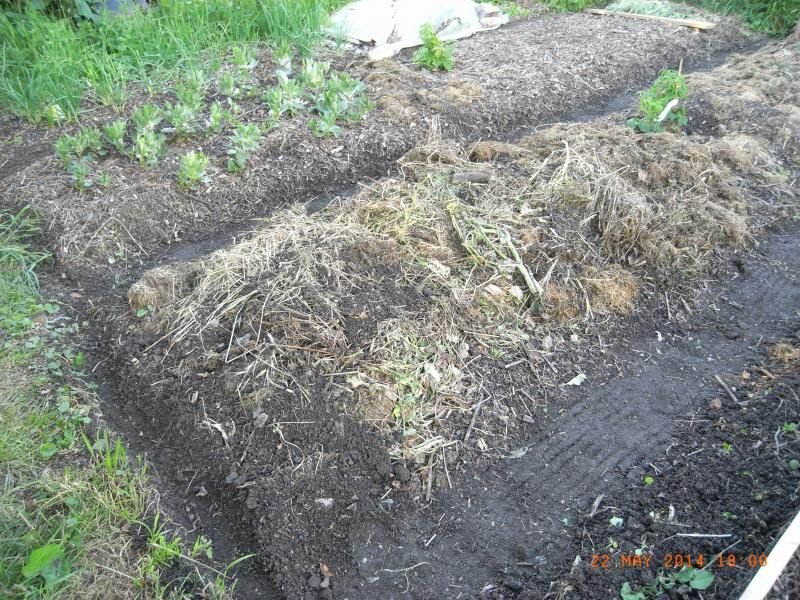
20 May 2014

A mulch of weeds and grass clippings
Compost

Bob Flowerdew is an organic gardener to be admired and respected:  he seems to take a scientific view of everything he does,  testing his hypotheses and controlling his experiments.   Sadly,  his book,  Composting,   makes the process seem very complex and very hard work.   If you want to know the details of garden compost-making;  this is the book to get.   But if you're a lazy gardener . .

If a mulch of weeds and grass,  and other organic matter,  is left on the surface of bare soil for a few weeks it starts to compost.

Humus is what the gardener wants,  and it is the main product of composting.  It absorbs water,  it releases minerals slowly so that plants can feed.  It is said to protect plants against diseases.
Composting weeds into humus can be complex or simple,  or anything between these two extremes.
Commercial composters make huge heaps with the right proportions of carbon,  nitrogen,  water and air.  Their heaps get hot,  and the thermophilic bacteria work fast to digest the complex plant molecules into humus.  The heat kills weed seeds and pathogenic bacteria,  and degrades proteins and pharmaceutical products.
Gardeners rarely achieve these efficient compost heaps.  Their heaps are smaller and cooler:  weed seeds often survive.  Some gardeners spend up to half their gardening time building (or buying) compost bins,  filling them,  mixing the contents,  turning the heaps and sieving the product.  Many of them spend hours of effort digging the resulting compost (excellent stuff!) into the veggie beds.  As they dig they destroy the mycorhiza,  kill the earthworms and damage the soil structure.

Other (busier or lazier) gardeners simply dump the weeds on an empty patch of soil and let the micro-beasts do their jobs.
Slugs and snails eat the soft leaves,  and digest the cellulose and lignin:  their droppings contain bacteria and humus.
Woodlice feed on the dead plant (and animal) remains,  digesting the cellulose and lignin and egesting humus in their droppings.
Fungi (yeasts and moulds) and Actinomycetes (filamentous bacteria) digest the lignin and cellulose of plant walls.  The less complex molecules produced are eaten (and digested) by bacteria.  The products of these digestive processes are carbon dioxide,  water,  heat and humus.
The fungi,  Actinomycetes and bacteria are eaten by rotifers and (along with large amounts of soil) by earthworms.
Three species of worms (Allolobophora longa, A. nocturna and sometimes Lumbricus terrestris) produce worm casts,  and so spread the humus on the soil surface (actually,  at the interface of weeds and soil!) while the rest spread it through the topsoil to a depth of a metre or more.

For the lazy gardener,  that 'mulch' of weeds (which prevents the soil from drying,  tends to inhibit growth of weeds and leaks a rich liquid into the soil) slowly turns into humus which the worms then 'dig' into the soil.
When the LG wants to sow seeds he simply moves the mulch to another place.