Across the fen

Across the fen
Showing posts with label Mulch. Show all posts

Monday, 4 January 2016

Shallots


"Plant on the shortest day, 
to harvest on the longest day"  from here

Since the last of the beans,  the bed had been mulched with a thick layer of weeds and grass clippings.
This was in lieu of a compost heap which had always seemed like a waste of effort.
The grass clippings had sunk down into a compact sodden layer.   The gardening experts tell us that a too-thick layer of grass mulch becomes an anaerobic stinking mess,  but this mulch had not yet begun to smell.
 
The matted layer lifted easily from the soil underneath.   The soil looked crumbly and worm-worked:  there was evidence of moles.   Some of the mulch would have been turned into worm casts which would have been spread across the interface of soil and mulch and taken deep into the ground.
 
The surface needed no preparation;  digging would have ruined it.
Forty shallot cloves from last years crop had been kept in a cool loft,  but about 50% had rotted:  perhaps they had not been dried thoroughly.   Twenty of the biggest bulbs were taken from the kitchen to replace them.
They were spaced along a marking board at regular intervals,  and each one covered with a clay pot to keep off the birds.

Monday, 2 November 2015

Asparagus and Leaves

Friday, 23 May 2014

Weeding

Weeds are good.
You should harvest them regularly and often to feed your compost heap.

Some weeds,  like docks,  cow parsley and mallow,  have very deep tap roots which penetrate the ground much deeper than your carrots or broad beans.   These roots collect water & minerals (plant food) and bring them up to the weed leaves.   By harvesting these leaves you transfer those minerals to your compost heap and bind them into humus.   When that humus goes into your vegetable patch it holds water and releases the minerals to your vegetables.   Don't bother to dig it under:  the worms will do that for you.   At the same time they'll create tubes and channels for water and air.

If,  while harvesting your weed leaves,  you didn't pull up the roots,  that's good in two ways.   First,  you didn't damage the vegetable roots which,  inevitably,  are intertwined with the weed roots.   Second,  you'll get another crop of weed leaves to harvest in a week or so!
Eventually,  the constant harvesting of its leaves will weaken the weed and the root will come out.   That's OK:  you've loosened the soil and you won't need to dig that bit!   You've created a long,  deep hole into which your plant roots can grow easily,  that worms can move in readily and which will carry water and air deep into the soil.

Other weeds are annuals.   They have shallow roots  which pull up easily,  and they make good compost.

Now that you can see no weeds,  sharpen your hoe (Yes: give it an edge like a kitchen knife!) and slide it through the top inch or so (no deeper!) of soil every couple of days.

And the compost heap?

Find an empty patch of vegetable bed and dump your harvested weeds there.   They'll cover the soil and prevent it drying out.   As they wilt their fluids will seep into the soil and feed the soil microbes.   They'll exclude light from the soil and so,  to an extent,  suppress the growth of more weeds.   The bottom layers will moulder,  and the fungi will convert cellulose and lignin into smaller,  humic,  molecules;  micro-beasts will come up to eat the fungi and then leave their dung in the soil.   The worms will leave casts under the weed heap,  and they'll 'dig' the soil for you.

When you want to sow seeds into that patch of ground,  simply move the heap elsewhere,  and sow the seeds.

Compost

20 May 2014

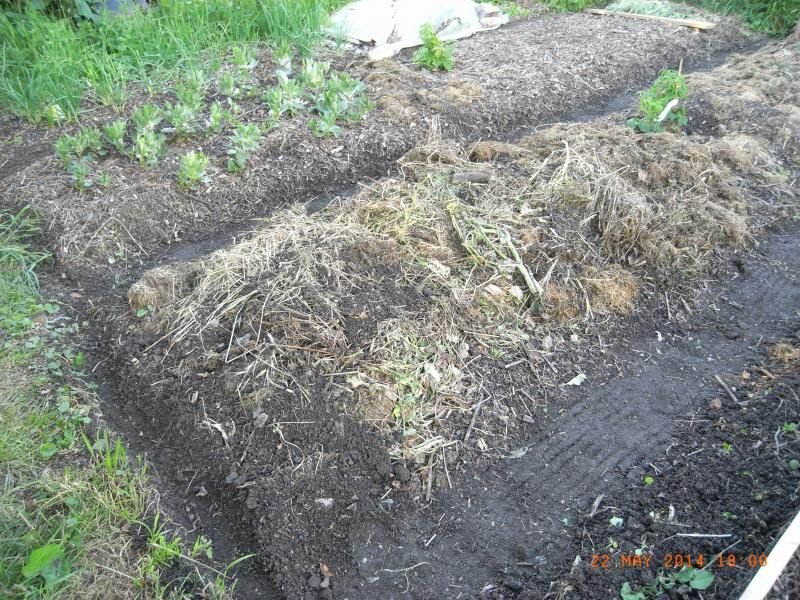
A mulch of weeds and grass clippings
Compost

Bob Flowerdew is an organic gardener to be admired and respected:  he seems to take a scientific view of everything he does,  testing his hypotheses and controlling his experiments.   Sadly,  his book,  Composting,   makes the process seem very complex and very hard work.   If you want to know the details of garden compost-making;  this is the book to get.   But if you're a lazy gardener . .

If a mulch of weeds and grass,  and other organic matter,  is left on the surface of bare soil for a few weeks it starts to compost.

Humus is what the gardener wants,  and it is the main product of composting.  It absorbs water,  it releases minerals slowly so that plants can feed.  It is said to protect plants against diseases.
Composting weeds into humus can be complex or simple,  or anything between these two extremes.
Commercial composters make huge heaps with the right proportions of carbon,  nitrogen,  water and air.  Their heaps get hot,  and the thermophilic bacteria work fast to digest the complex plant molecules into humus.  The heat kills weed seeds and pathogenic bacteria,  and degrades proteins and pharmaceutical products.
Gardeners rarely achieve these efficient compost heaps.  Their heaps are smaller and cooler:  weed seeds often survive.  Some gardeners spend up to half their gardening time building (or buying) compost bins,  filling them,  mixing the contents,  turning the heaps and sieving the product.  Many of them spend hours of effort digging the resulting compost (excellent stuff!) into the veggie beds.  As they dig they destroy the mycorhiza,  kill the earthworms and damage the soil structure.

Other (busier or lazier) gardeners simply dump the weeds on an empty patch of soil and let the micro-beasts do their jobs.
Slugs and snails eat the soft leaves,  and digest the cellulose and lignin:  their droppings contain bacteria and humus.
Woodlice feed on the dead plant (and animal) remains,  digesting the cellulose and lignin and egesting humus in their droppings.
Fungi (yeasts and moulds) and Actinomycetes (filamentous bacteria) digest the lignin and cellulose of plant walls.  The less complex molecules produced are eaten (and digested) by bacteria.  The products of these digestive processes are carbon dioxide,  water,  heat and humus.
The fungi,  Actinomycetes and bacteria are eaten by rotifers and (along with large amounts of soil) by earthworms.
Three species of worms (Allolobophora longa, A. nocturna and sometimes Lumbricus terrestris) produce worm casts,  and so spread the humus on the soil surface (actually,  at the interface of weeds and soil!) while the rest spread it through the topsoil to a depth of a metre or more.

For the lazy gardener,  that 'mulch' of weeds (which prevents the soil from drying,  tends to inhibit growth of weeds and leaks a rich liquid into the soil) slowly turns into humus which the worms then 'dig' into the soil.
When the LG wants to sow seeds he simply moves the mulch to another place.