Across the fen

Across the fen
Showing posts with label Creek. Show all posts

Sunday, 20 March 2022

'New Moon'

 New Moon is a smart-looking boat,  and it’s owners are a lovely couple.

It’s kept moored in a tidy circular creek near Bottisham Lock,  and brought upriver to The Plough for hirers to board.


At The Plough it shares a mooring with Rosie,  Princess Charlotte and a couple more of Peter’s boats.   Not always a comfortable association but it works most of the time.


A year or so ago the old man had given Gary his card.   They’d chatted amicably for a few minutes and the old man had thought no more of it.


Then,  a week or two ago,  Gary had ‘phoned to talk about handing over the boat and training the hirers.


Owning a boat which you hire out is at first exciting,  but,  like all jobs,  it can become tedious.

The old man went on board at 1000 and was shown ‘the ropes’.   The multi-fuel stove in the lounge and the diesel-powered heater are very promising for chilly evenings on the fens.

The dining area seats four cozily around the table,  where the old man settled himself with a book from the well-stocked shelf.

The galley is a dream,  even for a culinary dunce like the old man.   An electric fridge,  a gas hob and oven,  pumped hot and cold water at the sink.

The heads are definitely not a perforated plank across the bowsprit;   Instead,  a sparkling electric macerated system.   The shower is pumped and,  as always,  the sump is pumped over side.

Right aft is a big double bed.


The hirers were late;  very late.   They’d come a long way,  and the dog had needed several comfort stops.


But,  at last,  the old man came into his own.   With the boat under way,  and the crew capable,  his job was delightful and easy.   Even the gongoozlers at the lock had no complaints.


The old man loves narrow boats.

They are perfectly designed for their original job of carrying goods along the canals and through the narrows.

When the rivers,  and then the canals,  were the highways of England boats up to 70ft long (but only 7ft wide) could be drawn by two galloping horses and carry 30 or 40 passengers,  or several tons of goods at  over 10mph from city to city across the country.

Forrester wrote vividly of a dash from Gloucester to London in less than 2 days,  horses changed every 20 miles or so.

Now,  passengers travel as tourists,  not traders,  and the narrowboats no longer carry sharp scythes to cut the tow ropes of slower boats.

Staunches were replaced by locks which,  especially the long staircase flights,  are marvels of 18th century engineering.   So easy to use if the boatman is patient.

Now of course,  the boats are powered by diesel (even electric) engines.   On the Cam even the locks are electric.

Saturday, 8 October 2016

DCA Medway Cruise

At seven o’clock on a Saturday morning in June the M11 and the M25 were plagued with weekend drivers,  but it took Opal,  on her trailer,  less than 90 minutes to reach Upnor and the Medway Yacht Club.   The seeds of the cruise had been sown in March,  when John Basley,  from the MYC,  invited the Eastern Region to launch from their slipway on the North bank of the Medway,  and had germinated into conversations with Steve the Bo’s’n and Catherine the Sailing Secretary.   The cruise had blossomed with a conversation between John,  of the DCA,  and Norman,  of Lower Halstow Yacht Club which would make the Eastern Region members welcome on Saturday evening.

Opal was off her trailer and waiting on her launching trolley when Dave arrived with his Roamer.   A few minutes later Mark arrived,  expecting to sail with Gerald.   Opal and the Roamer were afloat and waiting when Gerald trailed Susie to the slipway.   As she launched John and Opal were a mile or so downriver,  running before the Westerly wind against the new flood.   He ate lunch in the cockpit,  under way,  keeping clear of the two coasters carrying the flood upriver,  counting the buoys as he passed them and watching the thick,  black thunderclouds gathering overhead.

The first few drops were big and heavy,  dimpling the river and killing the wind.   As the shower strengthened the drops became hailstones,  turning the water into a seething,  bubbling froth.   The ice accumulated in the little boat and on the skipper’s drysuit until he was sitting in an ice bath.   As the hail and then the rain abated the black clouds lowered,  flickering with lightning and deafening with thunder.

As the storm moved away to the East the wind returned gently and he was able again to count off the buoys.   The PHM ‘No 16’ was mistaken for ‘No 14’ and he crossed to the South bank looking for the two cardinals.   The flood,  now at its strongest,  carried him into Half Acre Creek and he spent an anxious hour struggling out again.   And there,  around the corner,  was the real ‘No14’ and beyond it,  the cardinals at the mouth of Stangate Creek.

During the storm the wind had backed toward the South West so that,  in Stangate Creek Opal tacked with long boards to the S’E and short boards,  back against the flood,  to the West.  At the mouth of Halstow Creek the wind was exactly contrary;  the creek itself was a maelstrom of breaking water.   With Opal deep-reefed the boards were equal,  but even with the fair tide flooding up the creek each one gained no more than a hundred metres or so to windward.   When,  occasionally,  Opal refused to tack and had to be gybed around there was no gain at all and even a loss.
Dave later estimated this wind “at the top end of F5”;   he and his Roamer wisely anchored in Stagnate Creek during the worst of it.   At the same time Susie was safe somewhere in the maze of channels East of Stagnate Creek;  neither Mark nor Gerald was able to say quite where!

As Opal finally rounded the corner into Halstow bay the wind died away and a weak sun came out.  Under full sail she glided across the flat water toward the LHYC clubhouse,  passing smoothly between the moored yachts and whispering into the grass an hour before HW.

Ken,  a member of the LHYC,  had prepared his sailing yacht and was waiting for the DCA members at the landing stage.   John secured Opal to a post and Ken showed him the clubhouse,  how to operate the door lock,  the location of the kettle,  the microwave and the shower.   Was ever a soaking sailor made more welcome?!
And there,  coming round the corner,  were the Roamer and then Susie.   Before they were halfway across the bay both dinghies were under oars and being rowed the last half mile to the jetty.

The Three Tuns was packed and heaving with marathon runners who had run an extra ten miles to celebrate and were now rehydrating.   All tables in the restaurant had been booked weeks ago (Saturday nights are popular,  and it’s a lovely pub!) and there was a waiting list for tables in the bar,  but eventually one came free and the four sailors dined and supped.

Medway Estuary


Four o’clock on a Sunday morning.   The last quarter of moon was high in the South and the air was clear and dry and calm.   The tide,  following the moon,  had covered the mud in the bay and would reach HW at about 5.15.   Opal was afloat by a quarter to five,  moving gently through the moorings on the slack water.   The light Westerly wind and the new ebb carried her East down Halstow Creek and North down Stangate Creek.   At the cardinals both wind and ebb were dead against her.   For a futile hour she made no progress upriver at all,  and eventually anchored on the ledge between the East Cardinal and the Isolated Danger for a second breakfast.
To the East Dave’s Roamer,  and then Susie,  crept out of Stangate Creek and turned right toward Queensborough.   They intended to wait for a few hours,  perhaps over lunch,  and then catch the new flood up to Upnor,  but,  within the hour,  the Roamer appeared,  tacking upriver.   For a boomless standing lug she sails remarkably close to the wind!
By  eleven o’clock John had also tired of waiting for the tide and weighed his anchor - which refused to leave the bottom!   Eventually,  he cut the rode,  losing the anchor and committing himself to the wind and tide.

The long beat upriver was concentrated sailing,  both tiring and relaxing,  stimulating and exciting.   Keeping the boat as close to the wind as she would lie while keeping the speed up to cover the tide.   Judging the moment to tack before running into the muddy bank yet using as much of each board as possible.   Estimating by eye the potential collision courses with other boats,  their tack and angle to the wind,  and then deciding which of the blighters had even seen him and which would ignore him.   A cheery wave to those who clearly knew the Rules!

The new flood helped to carry the three boats the last mile or so;  and then the back eddy at the slipway took them each in turn by surprise.
The electric winch was a blessing,  the club restaurant and bar was welcoming and the club officials were very friendly.

The boats were loaded and secured and the motorways were relatively clear.   The delay at the Dartford Crossing was normal.

Tuesday, 4 October 2016

Christmas Eve, 1963


Christmas Eve,  after luncheon,  and he was bored.   There would be afternoon tea later,  and then the long evening toward Midnight Mass.   He could read through the long,  deepening gloaming,  but there was always the ambiguity:  they became irritated by his reading:  "Always has his head in a book,  but never in his school books."

It was a bright clear afternoon (decades later he would know about high atmospheric pressure in winter,  that the evening would cool and the night would freeze) as he and the dog walked up the hill,  across the fields behind the house.   Across the next field,  and the next (the hedges and fences were no barrier to a skinny,  teenaged country boy and a small mongrel dog);  over the brow of the hill and then down across the fields to the South East.   The A482 was somewhere to his right,  the lane to Glan-Denys ahead in the valley.   There was always water at the bottom of a valley.
The copse was unexpected,  a delight,  not an obstacle.   And then the lane in the valley.

The lake was a total surprise:  he'd had no idea.

Back in the summer he and his sister,  together with her would-be boyfriend Cornflakes and a girl from Lampeter,  had borrowed his father's Vauxhall Velox to get to the cinema in Aberystwyth.
Driving was a great pleasure.   The long,  narrow swooping roads to the coast were a joy.   The big car purred as it swept them along.   The others chatted as he revelled in his skill.
The attraction at Aberystwyth?   The film,  Summer Holiday,  starring Cliff Richard and The Shadows.   He'd been astonished when his sister and the girl had screamed every time the star appeared,  and especially when he sang.   Even Cornflakes,  round as he was,  bounced up and down in his seat with excitement!
Eventually the tedium ended,  and he was able to drive them home:  Cornflakes to one of the little coastal villages,  his sister to Pantcoy and then the girl toward Lampeter.   Around the bends and down the hills,  with no-one to talk to,  she became anxious and was clearly car-sick.   She began fumbling with the door handle.  He swerved off the main road,  into the lane and stopped in a layby.   She threw open the door and was violently ill by the side of the lane.   He fetched water from the stream and she drank and washed her face.   Gently and slowly he drove her home.

As he crossed the lane,  on that cold Christmas Eve,  there was the layby.   The puddles of vomit,  along with the memory,  were long gone.   And there,  on his left,  was the lake.   It's gravelly shore stretched at right angles to the road.   And on the shore was a raft.   The usual thing,  nothing special:   A few planks lashed to four oil drums.
It took a matter of moments to drag it into the water.   A long stick served as a pole,  and in a few more moments he,  the dog and the raft were a hundred yards from the shore,  and sinking.

He'd spent the past 12 years or so in West Wales with parents and younger sister.   The past 5 years had been at Aberaeron County Secondary School,  on the coast,  where every window overlooked Cardigan Bay,  where lunchtimes were spent on the beach or around the harbour.   
The family holidays were spent in a caravan at New Quay (the Welsh one,  not the Cornish one).   He and his father looked longingly at the sailing dinghies drawn up on the sand,  and at the trip boats in the gentle surf,  and at the mackerel boats as they brought their catch in for the holidaymakers.   They knew every inch of every plank and line;  every ha'lyard and stay;  every gun'l' and thwart;  every jib and main.   In theory they could sail every one of them.   
They knew the intricacies of the British Seagull outboard engine,  how it worked and how to operate it.   Even the magic of the misunderstood air-bleed screw!
They had once,  as a family,  taken the paddle steamer from Barry to Weston-super-mare.   And back.
Sundays out were spent at Llangrannog,  further South down the coast.   His parents and sister were good swimmers;  aunts,  uncles and cousins,  when they came to visit from England,  were excellent swimmers.   He hated swimming and scorned all attempts to learn or be taught.   Boats were the thing:  they kept you dry.

And now,  for the first time in his life,  he was afloat on his own,  sinking,  craft.   Alone on an isolated lake in a Welsh valley.   There was a skim of ice across the surface which broke as he paddled with his stick to get the doomed raft back to the beach;  a thicker patch of ice broke the stick and left the stub in his hands.

Water welled up between the planks and froze at the edges.

No problem;  the dog's lead (string) was long.   Push the dog into the water,  it'll swim to the beach and pull the raft along.
The dog didn't agree.  It scrambled back onto the edge of the raft,  its efforts pulling that edge a few inches lower into the water.  
But that lifted the opposite edge a few inches out!  He knelt at the edge and began paddling with his hands.  His hands and the dog's hind legs combined to drift the waterlogged craft back toward the beach.   It ran aground,  and he waded the last few feet.

As he slipped quietly in through the back door his trousers,  from the knees down,  were rock hard ice.   His shoes and socks were sodden.   The dog was dry and as happy as he.

Afternoon tea was long past, and they served nothing but tension and unanswerable questions.

Midnight Mass was utterly tedious. 


Wednesday, 11 February 2015

Out of Brancaster

Brancaster is a little village on the North Norfolk coast. The staithe is a gravel track and beach onto a tidal channel which, at low water, dwindles to a muddy creek winding through the salt marshes.
Sailing is alive and well. The higher parts of the bank, not quite reached by the Spring tides, has rows of sailing and rowing dinghies. There is a yacht club, and the yachts are moored in the creek. Across the road is a well-advertised RYA training centre.

The Harbour Master is a laconic, friendly man who clearly knows the creeks and marshes well. He once knew, and sailed with, Frank Dye: that is testimonial enough for any sailing man. He gave the impression of ruling his littoral empire with a firm hand: he wasn't going to let Opal into his water until he was sure her skipper knew what he was doing.
She arrived fairly early, to a deserted staithe. As she was eased onto her trolley, her gear loaded and her mast stepped, sailors stopped to admire, to comment and to ask. The process of rigging takes twice as long at the water's edge as it does in her home driveway. Everyone takes an interest.

Eventually, with the car parked and the trailer padlocked, Opal slipped into the water. Her wheels were moved from under her keel and stowed above the stern locker. Her skipper made himself comfortable in the after seat, and she floated out into the moorings.

The Mirage drive is very deceptive. In calm water like this Opal glides along remarkably quickly. The muscular effort is far less than paddling a canoe or kayak.

East of the moorings, her sail was unfurled. Despite the absence of a boom Opal sails fairly close to the wind. Not as close, obviously, as a Bermudan rigged dinghy, but what she lacks in windward ability she gains in speed. Only in light winds need the sail be fully unfurled.

The channel at Brancaster curves in a long bend Eastward through Northward and then Westward, widening as it does so. North of the creek which runs East to Overy, the channel is exposed to the North Sea. At this state of the tide, about two hours before high water, the outer banks were covered; the wind turbines turned slowly in the haze.

A twenty-two foot Jaguar, under engine, turned abaft Opal's stern as she tacked to the North-West, the two crew calling a cheerful greeting.

A little gaff cutter with tan sails (perhaps a Cornish Shrimper?) followed Opal tack for tack, but falling behind. As Opal turned toward the West and over the bar, now safely under several metres of tide, the little cutter sailed N'East to play and tack under the lee of the banks.

Now clear to the North of the bar and the banks Opal began to feel the short swell of the shallow North Sea. She has a way of rising to the coming wave, climbing the face, cresting the ridge and then smacking half of her eighteen feet down into the following trough.

Roughly in the spot where the fairway buoy used to be, Opal's skipper noted the bearing to the Golf Club and its lighthouse, the angle of the approach channel and the breakers over the banks to the East. He furled the sail, broached the coffee flask and opened his packed lunch.

The early Autumn sun was warm, the breeze gentle from the N'East. The padded seat was comfortable, the motion soothing.

At the top of the tide a couple of yachts sailed in from the North and across the bar into the channel. Away to the S'East the tan sails tacked across the flat water in the lee of the banks. The wind turbines continued to turn lazily in the haze.

Smoked salmon and pastrami, with grapes. Black coffee. Cold, clean water. A chocolate biscuit. The sea curiously warm. The swell rising and falling like the heaving chest of a sleeping monster.

Lunch over, Opal turned South and East, bouncing over the short swell and then, in flat water, planing along, windward ama in the air, the hull and l'ward ama fast-skipping across the ripples. A crossing tack with the little cutter, Opal passed well ahead and hurtled onward. As the channel curved she bore away further under the N'Easterly breeze until she was running downwind toward the moorings. Reefing half the sail did nothing to slow her progress. Finally, down to a scrap of triangle, she cruised into her landfall.

Sail furled, Mirage drive out, centreboard and rudder up, and Opal scraped her bows onto the shingle. Her skipper stepped out into inches of water, hauled her dry and unstepped her mast.
Brancaster is a place to visit for a day on the water. Opal is easy to launch and recover, the staithe is quiet and friendly and the water is a calm expanse or the open sea. A perfect day out.


2 October 2015

In the August 2015 edition of Practical Boat Owner Andrew Simpson suggested using the Navionics WebApp for harbour planning.   It can’t,  he suggested,  be used for passage planning because it has no lines of latitude or longitude and none of the functionality of the full application.
It does,  however,  have a scale cursor which can be orientated North-South,  or East-West (or indeed any other direction).   Perversely,  it calls this orientation “Heading”, which it most certainly is not.
The bearing from Brancaster to Skegness is 311°T,  a little over 15 miles.   There and back might be a decent one-day cruise.
‘Woolpack’ PHM is part way along the bearing line,   6 miles from Brancaster and about 10 from Skegness:  well situated at the centre of a GPS web for the little hand-held Garmin GPS.

Opal arrived Brancaster 0900 and was rigged and afloat by 0945.   Half a mile down the channel,  the skipper realised that the bungs were not tight and that the hull was taking on water.   He put ashore to drain the water and tighten the bungs.   Was this an omen?   A superstitious sailor might have had second thoughts.

Leaving Brancaster was easy:  East down the channel through the moorings,  North to the channel markers,   West to the golf club and then onto a heading of 315°T toward Skegness.
The presence of the wind farm made bearings and headings almost redundant. It was huge,  and it's presence dominated the Northern skyline.

The morning shone and the sea sparkled.   The slight state of the sea provided a popple which made Opal lively,  and the gentle Easterly breeze kept her moving at 4 to 5 knots over the ground.

A white patch on the horizon might have been buildings on the Skegness coast,  so was kept on a constant bearing.   It turned into a ship,  which was not moving,  but needed to be avoided.   In any case,  the SE corner of the windfarm was kept fine on the starboard bow.
The ship became Stril Explorer flying "restricted in ability to maneouvre" above and abaft the helicopter landing platform.   Either the tide was pushing hard to the North (bearings on a couple of buoys made this seem unlikely) or she was moving sideways to the South?
A crane on her port side was deploying something that might have been an ROV.
Opal passed her to the South,  having found 'Woolpack' PHM exactly where it should have been.
Then a heading of 315°M picked up the Special marker on the SW corner of the wind farm.

Calculation of the tides suggested that Opal should turn for Brancaster at about 1330.   In the event (perhaps a mistake) she  pushed on until 1400,  about a mile and a half from Skegness beach,  before turning SE close hauled.
Was this success or failure?   The objective had been to reach Skegness:  did that mean landing on the beach,  or was a mile away good enough?
The skipper didn't really care:  it was a wonderful day,  he was warm and the boat was behaving beautifully.

On the way back he kept the little boat close hauled,  steering between 120° and 150°M:  this kept Brancaster on a constant bearing of 140°T.   But then the skipper needed to pass water (again!).   This meant furling the sail and the complicated ritual with the dry-suit.   They drifted downwind,   West and a little South,  until,  when the sail was set again,  Brancaster had come to 120°T.   Close-hauled and with significant leeway Opal could not now make the harbour on this tack.

The North Norfolk coast is fairly featureless,  especially in the gloaming,  but a building on the shore looked very like the golf club.   The chart suggested it had a lighthouse?   At what time would the light be lit?   How far East should Opal go before looking for the channel?   Which would come first;  darkness,  the channel or the lighthouse?

As the golf club came abeam darkness fell like a slowly lowered blind.   Random red or green lights,  sometimes long,  sometimes short,  often absent,  hinted at the channel.   Opal crept forward,  against the faint breeze,  with the tide and controlled by her pedals and rudder.   The surf crashed somewhere to starboard (perhaps the shoreline),  and a long way to port (perhaps Scolt Head?).   Now the channel markers became more consistent.   Heading East gradually became heading South and then West.   The Staithe ran South from the East-West arm of the channel,  but the blind of darkness concealed everything.   A yacht,  moored in the channel,  wisely showed an anchor light at the top of the mast.   But it dazzled Opal's skipper and ruined his night vision:   the darkness was deeper than it need have been.
The Staithe could not be found and now Opal was too far West and the flood was running fast.    Turning East,  the Mirage drive made desperately slow progress,  and Opal turned into a pool amongst the marsh grass for a pause,  a rest and a meal:  time to think.   And to wait for the moon.   She would reveal everything.

As the last quarter rose from the Eastern horizon so did the clouds.   Nothing was revealed.

As the tidal stream lessened toward high water Opal again moved East,  searching for the elusive Staithe.   Five times she ran aground on the marsh grass exposed by the falling Spring tide,  and five times the skipper dragged her off into deeper water.   He was exhausted.   It was 1115,  and he had been awake and navigating,  by road and by sea,  for over eleven hours.
A mooring buoy appeared between the hull and the port ama:  he grabbed it,  and made fast the painter.   Time to rest.

The tiny cockpit of a Tandem Island is perfectly shaped for sitting.  The seat can be adjusted to sit upright or to recline.   From it the boat can be sailed,  paddled or pedalled in complete comfort.
It is the worst place in the world in which to sleep.

Shivering is good;  it keeps your muscles working and your body warm.   The time to worry is when the shivering stops.  They kept shining that light,  faint but soul-searching,  across his face.   Was this some kind of cruel joke to keep him awake as he tried to sleep . . . . ?   And that hideous screeching racket,  like seabirds fighting over scraps of fish and chips?  And the smell of stinking East Coast mud.

Two o'clock in the morning.   The seabirds were fighting over worms and shelled things in the mud.   The last quarter was shining through the thinning cloud.
With the tide ebbing,  and the banks exposed,  the Staithe might now be easy to find.
Sitting up and persuading cold,  cramped limbs to work was hard,  but ultimately successful.   Released from her buoy Opal responded to the fierce ebb,  being swept along with no chance of entering the Staithe,  even if it could be seen.   Which it couldn't.   Eventually she came to rest on a sandbank,  and the water became little chuckling channels which dwindled and dried. 
Back to the curled,  cramped,  confined cockpit.

That light is too bright,  but the air smells fresh and clean and the screeching has turned into vigorous honking.

Five o'clock.   The Eastern sky began to glow rosy pink and gold.   The sand was firm (in places).   A fisherman trudged across the estuary,  waded through the river and crossed the marsh on his way to his boat.   The tide probably turned at five and might lift the boat at seven-ish.
He dragged the Hobie into the river and began to haul it upstream.   Every hundred metres or so it had to be pulled across sandy shallows bedded with soft silt (quicksand?).
And finally dawn.   And then the Staithe,  clear and obvious with all the familiar land- and sea-marks to guide him in.

He pulled the boat up onto the shingle,  unstepped the mast,  collected the bag of instruments and guided his groaning legs to the car.   Removing the dry-suit (he'd worn it for nearly 23 hours) was a profound relief.   Comfortable shoes,  and then back to the boat.   Day sailors were preparing their dinghies and outboards.   A small group was helping a newcomer rig his Wayfarer,  and park his road trailer.   An efficient-looking sailor carried a bundle of boat cover from his dinghy to the clubhouse.   The Staithe was waking up to weekend watersport.

At the shingle he watched in disbelieving horror as the Hobie drifted up-channel on the tide.

A group around a Wayfarer confirmed that they had no safety boat to help and would not themselves be on the water for another hour.   Two men with an outboard dinghy pondered on where a drifting boat might end up,  and whether it would be accessible,  and that the channel upstream would be too shallow,  and that it might end up neaped on the marsh.   Perhaps it would float back on the ebb?
The efficient-looking sailor was just that.   He and the Hobie skipper embarked in the tiny dinghy and set off after the errant trimaran.   Twice they ran out of water,  and had to look for another way.   Eventually,  with the Hobie entangled in a mooring line just twenty metres away,  they stuck fast on a bank.   The skipper stripped off his shoes and socks,  jumped in knee-deep and ran toward his boat.   He was barely 5 metres away when it untangled and drifted off again.   And now he was thigh deep in a rising tide. 
The efficient-looking sailor had shipped his oars,  found a deeper channel and caught the runaway!
As he brought it back the skipper was waist deep and preparing to climb onto a moored boat.  Instead he boarded his Hobie,  and steered it behind the tiny dinghy back to the Staithe.   The efficient-looking sailor  brushed away the profuse,  embarrassed,  inadequate thanks:  "You'd do the same for me;  I know you would.   Anyone who wouldn't isn't worth knowing."

This time he dragged the boat out of the water completely,  and up the bank.   He ran to the car,  hitched on the trailer and hurried back to the boat.   It's stern was already in the water!   As he loaded it onto the trailer the Wayfarer sailors launched around him,  oblivious to the ending of the dangerous drama.   The efficient-looking sailor had loaded his passengers into the dinghy and was taking them down-channel to the boat.   Saturday morning,  and life was perfectly normal.

Back in the car park,  he secured the boat,  the trailer and the car for the journey home.   He was aware that,  in his exhaustion,  he had made dubious,  dangerous decisions.   Now everything must be checked and double-checked.   Every part and component must be touched and confirmed.   Today the sea had teased and then forgiven;  the road would not be as friendly.
Even so,  he had to stop after half a mile to fasten his seat belt!
At the little cafe the coffee was hot and strong:  he drank three cupsful,  and then sat in the car to get warm and to let the caffeine do its work.

The road journey was totally uneventful.

Days on the Deben

22 September 2014

Titchmarsh is a good place to launch.
It's just over 90 minutes from Cambridge; not quite the nearest piece of tidal water, but better than many.

There was a new regime at Woolverstone, on the Orwell. The new manager was a nice, friendly chap, prepared to let Opal launch for half price: just £16.00. It still seemed like a lot of money for a few hours on the water. The next time, he was off-duty: his accomplice (sorry, assistant) charged the full £30.00. That's £1.67 per foot. Somewhat bank-breaking. On the other hand, the crew gets access to the heads and showers: quite necessary after a few hours on Opal. The Buttery is pretty good, too.
But Titchmarsh charges half that rate. It has excellent showers and a good restaurant. The slipway is a little bit easier, too.

Opal always takes longer to rig than she should. People stop, and talk, and ask questions.
That's all very pleasant and friendly, but the tide had turned at 1140, and the channel was long and winding.

By 1230UTC she was on the water, wheels stowed, Mirage drive fitted and skipper settled with his laminated charts, VHF and coffee flask.

The Eastward branch of Twizzle Creek was downwind; a fast, smooth run between the moored boats. Walton Channel was a fast reach. At Island Point NCM the channel had become tortuous: the Mirage drive again showed its worth, making the transition from sail to "power" effortless and smooth.
The channel across Pennyhole Bay was straight, NE by N, and Opal was making for Landguard Point.
The only danger was being carried too far East by the tide ebbing from the Stour and the Orwell.
And, of course, the ships in the deep water channel out of Felixstowe and Harwich.
With the gentle breeze and the North-going tide Opal made 6 knots over the bay and across the channel: not a moving ship in sight!
By 1535, off Felixstowe town, a small chop had developed. Opal began to leap from crest to crest, hurling clouds of spray and volumes of water to drench her exhilerated skipper.
At 1600 Bawdsey SWM came into transit with W Knoll PHM, and Opal hove to. She was nearly 2 hours too early for the first flood into the haven. In all probability, water would continue to pour out of the Deben long after the new flood had started.
A small trawler moved South, turned at the SWM and moved North. It turned again, coming South a mile to the East. North again, on its endless search for bottom fish. Finally, it turned into the Deben, demonstrating to Opal's skipper that, at slack water in the open sea, the river basin was still draining.
The dilemma began to crystallise. Opal needed a friendly beach before nightfall. She must go in soon, ebb or not.
The mile or so between W Knoll and the anchorage seemed endless. Not directly upwind, it was still too close for the sail to help much. For an hour or more the skipper's legs pumped at the pedals: the occasional spasm of cramp had to be ignored: to stop pedalling would mean being swept back to sea. Opal slowly gained ground.
In the breakers, outside the shingle, a young man paddled his board out to sea, then rode the crests in toward the bank. At the end of each run he was hurled head over heels by the tumbling breakers. Then he emerged, stood on his board and paddled out to sea.
He was still there, still playing, as Opal passed the ferry and slipped into the placid waters of the anchorage.
As the sky darkened the tide began to help. But there was still light enough to see that the banks were wide expanses of mud. East Coast mud. Black, stinking mud. Thigh-deep, sticky mud. Mud conquered by Charles Stock, with his long wooden planks.
Mud that an exhausted old man could not cross hauling his boat, however light.
'Round the bend, in the gloom, was a miracle crossing all the mud into the water. A floating pontoon. Opal moored alongside, and her gear was carried to the shore. In the wind-lee of the flood bank a few square metres of grass was perfect for the tent. The tea was black and bitter and hot. The meal was tasty and varied and hot. The sleeping bag was warm. The geese and the curlews sang a cheerful lullaby. The crew slept. 

23 September
The engine was quiet, but getting louder and closer. They would discover him trespassing on their pontoon, confiscate his ship and leave him marooned on the desert island. Pleading for his life would be futile. At least, the dishes had been washed . . .
Six thirty. He watched the two anglers motor slowly upriver. Behind the scudding grey and black clouds the sun had risen high. Again, the tea was hot and welcome. The porridge was hot and laced with condensed milk. The washing-up was easy. Striking camp was swift.
By 0830 Opal was drifting upriver on the tide. The wind on the water, though strong and driving thick clouds at altitude, came in fits and starts, now and then. Sometimes drifting, occasionally pedalling and often fast, brisk sailing.
The anglers had anchored their dinghy below the moorings at Ramsholt: Opal swept past, ignored and ignoring.
A couple of barges moored, or laid up, in the corner above Hemley, and then toward Waldringfield.
West of the island, the village and moorings at Waldringfield were from a picture book. The water was sheltered from the Westerly wind; pedalling gently was enough to maintain steerage way with the tide.
A long reach up toward Martlesham Creek, the little island almost covered by the Spring tide. Again, the mooring was sheltered, and the Mirage drive made easy work.

By midday Opal was gliding into Woodbridge. Pottering around the anchorage, she irritated a single scull teaching a very scared girl.
It's never really clear whether Opal is sailing or 'motor-sailing': the transition is easy and smooth, and she carries no cone. Most sailors are not irritated: more fascinated and questioning. The instructor was irritated, but probably had no concept of sailing or motoring. Other vessels were simply in the way, and he wanted to get his frightened student back to the boathouse ramp. Ferry-gliding is a sophisticated technique, difficult to teach even when on the same boat.

Opal moved out of their way.

The skipper knew Woodbridge well, but not from the water. The boatyards and boathouses were all there, but different. Most of the boats were there, but closer, more intimate, more real.
Luncheon afloat, drifting in the slack high water. Boat-watching. People-watching. Part of the scene, but detached, alone. Relaxed. Content. Cold pasta bake and water.
Then there was enough ebb to create a sailing breeze. Toward Martlesham Creek the wind strengthened. Flat water and a strong wind are the conditions for which Opal was created. The hull and l'ward ama hissed across the surface. Five times Opal skimmed along the reach, to and fro, flashing past the moored yachts, her skipper's heart singing with the wind and screaming with joy.

And then on down the estuary.

The moorings at Waldringfield were sheltered by the hill from the wind, which then swirled around the sailing club and sent Opal flying on again.
Past the moored barges the river turned South and a little West. Then Opal was drawing long boards across the water, changing tack in the shallows close to each bank.
Then South and East, with the wind on the beam, and Opal lifted her windward ama and hurtled on.
By 1500 she had reached her isolated pontoon and moored alongside.

Teatime.

A long walk along the flood bank to Felixstowe Ferry, and a cup of tea and slice of cake at the cafe.
A stroll around the boatyard and then a chat with the Assistant Habour Master.
"Take the flood down to the Backwaters." said he.
"Catch the last of the ebb out of the river: you'll have plenty of water for that little boat. Watch the buoys and keep away from the shoal opposite the tower."
At 1800, back at the campsite, the skipper pitched his tent and cooked supper.
A seal surfaced close to the water's edge, and surveyed the domestic arrangements. Satisfied, it slipped below the surface and vanished.
Low water would be at 0607UTC.

24 September
If the Autumn leaves continue to fall at this rate the bivvy will be completely camouflaged and no-one will ever know. Heavy, fast-falling leaves like storm-driven spray on the coachroof . . .
At 0330 a sharp shower rattled on the tent.
Breakfast, as always, was tea and porridge: hot fluids and slow-release carbohydrate: warming and 'wakening.
0530. The night was black. The all-round white on Opal's pole was blinding. The river was black, the anchorage was dark. No useful lights near the ferry: the entrance was invisible. The buoys in the channel were all un-lit. This was impossible: to leave in these conditions would be folly.

So back to the pontoon for a second breakfast, and more sleep.

At 1030 another shower of rain rattled on the tent. Again, the little camp was struck, the boat loaded and embarked. Slack high water would be around 1240, when the channel should be calm and, in daylight, visible. It would mean sailing South against the ebb, but the wind had strengthened again from the West.
At the ferry crossing the water was calm. In the channel the water was flat and calm, while the wind over the sea wall pushed Opal along. She was half reefed so as not to overtake the yacht ahead: it might show the way to the SWM.

At sea the wind had backed into the S'West, and freshened again. Opal bounced across a short chop, now and then slicing through in a shower of salt water. The yacht ahead stayed close inshore. Unable to sail as close to the wind Opal moved further out, heading South but making leeway to the East.
As the sea built Opal began to leap from crest to crest, often plunging through the next wave, never stopping.
A big yacht came close to the port quarter, its crew apparently anxious about Opal's intentions and safety. Satisfied, they bore away to overtake, then thrashed away through the chop on a fine reach to the South.

The ebb out of the Stour and the Orwell again became a worry. Opal's leeway threatened to take her East of the Wadgate Ledge beacon which, in these conditions, was too far. She needed to be close inshore as she passed Landguard Point to have any hope of reaching the Backwaters.
On the port tack she began to lose ground to the North. In 5 minutes she seemed to lose 15 minutes of ground gained, but she closed the shore. Now she could brave the deep water channel.

Onto the starboard tack again: a wild, wet, bouncing ride over the white caps: where had they come from? Again the wind had strengthened. Then the channel.
A vast container ship, leaving Felixstowe, was turning the corner at Landguard NCM. Opal would be swallowed by the bow wave and shredded by the screws. Onto the port tack again and close Landguard Point. Then onto the starboard tack to cross as close behind as possible.
Past Beach End SHM and there, approaching the corner, an even bigger ship.

No stopping now.

Opal flew across the channel, drifting downtide as fast as she moved forward. For a full minute, as it turned to port, the ship pointed its bows directly at the little canoe. Then they were clear, Opal South of the channel in the lee of Deane PHM, the ship presenting her vast starboard side.
Pennyhole Bay was a maelstrom.
The ebb from the Wallet meeting the mixing ebbs from the Backwaters and from Harwich was turned into a cauldron of white, breaking water by the S'Westerly breeze.
This was not exhilerating. This was hard, concentrated work. Keep the boat as close to the wind as possible, but keep her moving as fast as possible. This was frightening: a long, cold, hard fear that focussed the skipper's mind, lifted it above the thrashing breakers, and allowed it navigate and sail the tiny boat.
Transits on the Gunfleet Array showed that she was moving up to windward, but not fast enough. She would make landfall a mile to the East of Walton Channel, a little North of the Naze. Time to tack again.
Five attempts failed. The sixth, with speed and hard pedalling, succeeded. Once again, Opal was losing ground to the North.
Close to Pye End SWM she reached the channel, and again changed to the starboard tack. Now, in the lee of the land, it was plain, fast sailing.
Four o'clock, with the tide still ebbing out of Walton Backwaters. Titchmarsh Marina would close the inner gate at five thirty and Opal would spend the night in the dinghy compound. The campsite would be flat and fresh mown, the restaurant would be warm and friendly and the delights of Walton would be 5 minutes away. The tide of life was flooding again, even as the ebb of water slowed the boat.
Island Point NCM appeared on the starboard bow, the dogleg was easy with the wind on the beam and Walton Channel was a fast smooth fine reach through the moorings.
The Twizzle was hard work against the breeze and the tide, and then Opal slipped into the pool, the port ama was folded and she came alongside.
Fifteen minutes later, with five to spare, she was on her trailer, through the gate and into the car park. It took the exhausted skipper a further 90 minutes to load her gear and to secure the car and trailer.
Three days of high tides and low, high emotion and despair, exhileration and naked fear; the little boat had conquered it all and come home.

Tuesday, 29 July 2014

Woodwork and Boats

Jeremy Broun is a woodworker,  guitar maker,  musician,  writer and all-round good egg:  generous with his time and advice.
His blog cites his work and his thoughts,  and goes into some detail about his approach to woodworking and to life.
He has a YouTube channel with many videos devoted to woodworking and to his slightly off-beat approach.

Of particular interest is his design for a tiny electric catamaran,  for pottering quietly on the River Avon and the Kennet and Avon canal,  and which fits entirely inside his Smart car!   It would be equally delightful on any canal or quiet river in the country.   Perhaps not the tidal Clyde.

Electric boat engines have come a long way since the Thames launches of the mid 19th Century.   Agate herself has a Torqeedo which fits onto the standard outboard motor pad,  and has been used on both Welkin and her tender.   More modern motors,  carrying GPS,  have the ability to hold the boat within a foot or two of a specified position,  and can be controlled by a smart 'phone at a distance.
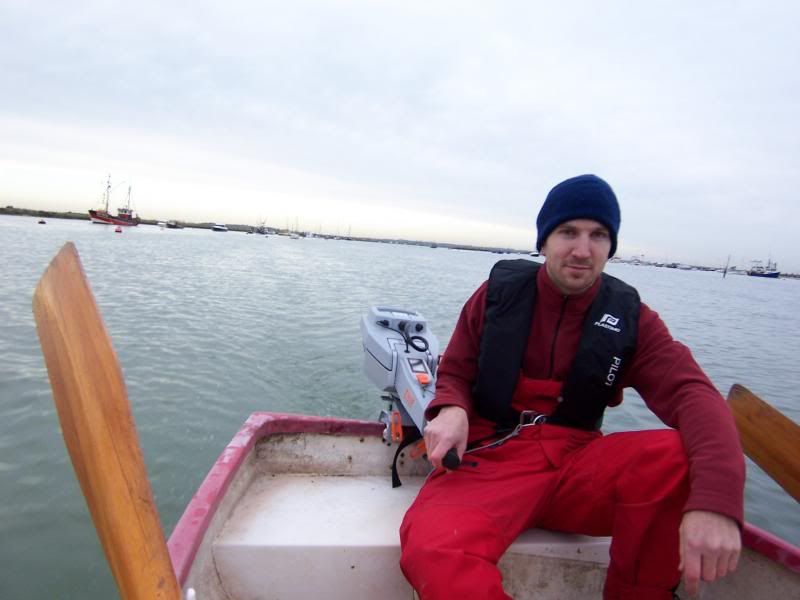
Skipper,  Torqeedo and tender
People worry about the range of an electric boat more than they worry about the range of a petrol or diesel boat.   The power density of a battery is far lower than the same weight or volume of petrol or diesel,  and batteries take much longer to refill than do petrol tanks.
But,  as with all things,  range is inversely proportional to speed.   The faster you go,  the less distance you'll cover on one filling.   The slower you go,  the longer the pleasure will last.

A year or two ago StJohn and his Dad turned up at West Mersea on a cold,  cloudless,  windless winter morning.   It would have been a crime to have shattered the anchorage with Welkin's air-cooled,  two-stroke outboard.   Instead,  they attached the Torqeedo to the tender and,  at a silent 2 knots,  explored every square inch of every channel and creek.   You won't find a noiseless ICE!
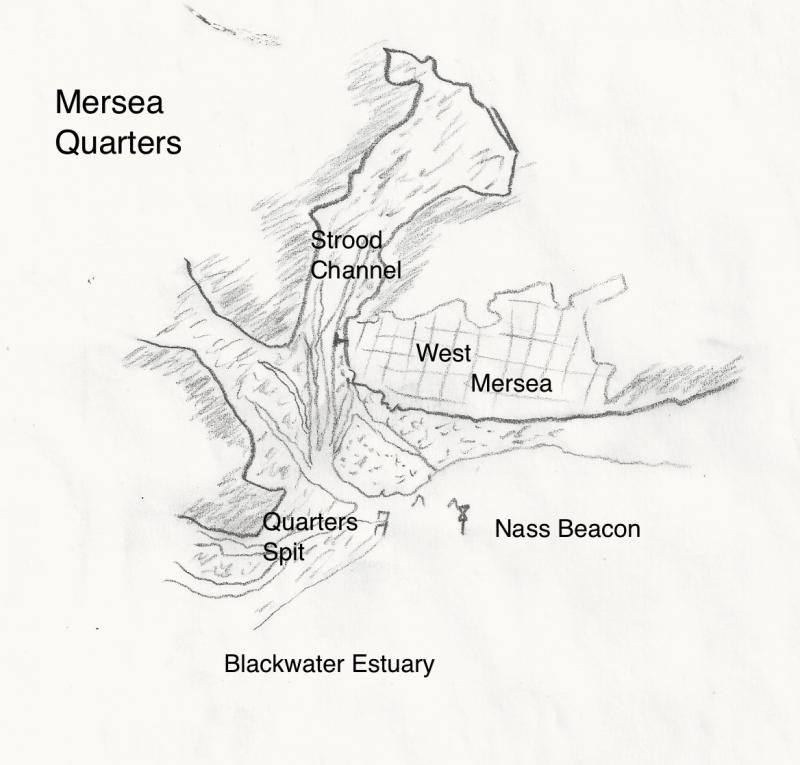
West Mersea and the Quarters

The engine's digital display showed the speed (over the ground),  the power consumption,  the Kwh left in the battery and how much farther it would take the two intrepid navigators!   You don't get that with a petrol tank!
Many skippers had chosen that calm morning to carry out small repairs,  to whip neglected rope ends or to drink tea in the cockpit.   t/t Welkin would glide alongside and silently (and exactly) stem the tide whilst skippers and mates exchanged pleasantries.   You can't do that with a British Seagull!

The smacks lay perfectly still at their moorings as our heroes moved quietly around them,  seeing the strakes under the paintwork,  tutting at the tiny streaks of rust,  marvelling at the long bowsprits and admiring the curved,  graceful counters.   The mirror images shimmered and bobbed in the dinghy's wake,  and then relaxed into shining immobility.
.
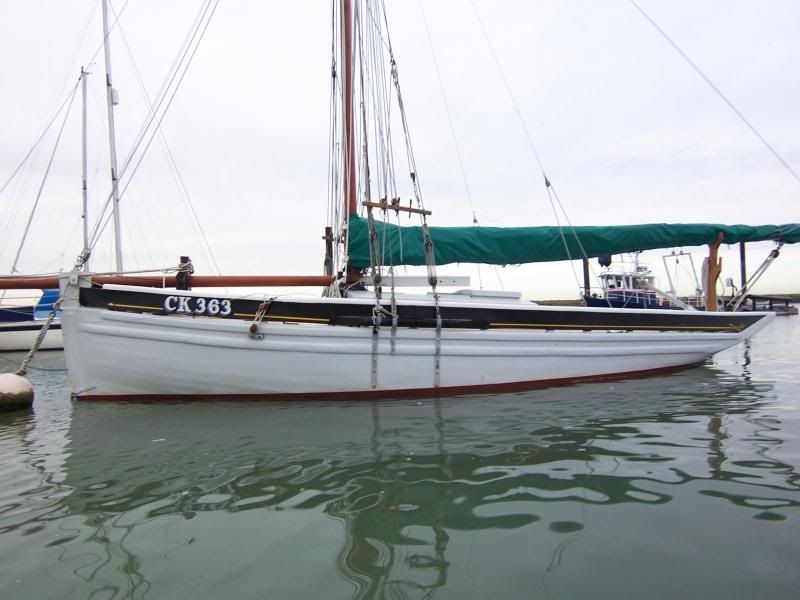
CK363 in Strood Channel

There was almost no conversation;  it might have disturbed the birds feeding in the mud,  sleeping on the water,  floating in the cold,  still air.   Certainly no need to shout.   Without hurry,  the batteries lasted all morning.

This could have been the first realization that a small boat is better than a bigger boat.
The definitive moment came a year later,  as StJohn rowed the tender through an angry,  turbulent channel in the teeth of the yachtsman's gale which had prevented him taking Welkin to sea.   He was focussed;  concentrating on the oars,  the chop,  the wind direction,  the tide and his destination.   He was the entire boat,  at one with his microcosm,  alive in the moment,  weighing and accounting every variable as it changed,  moment by moment.   Oblivious of his shipmate and of the world.
At other times StJohn is very aware of the rest of the world.   Like Jeremy,  he lives in and among the world,  carving his own niche,  creating his own wake;  sometimes across the stream,  occasionally at odds with the popular view.
You may not always agree,  but they are both worth hearing.